What it tells the engineer
A cone pushed into the ground at a steady rate records tip resistance and sleeve friction continuously with depth. With a piezocone (CPTU), it also records pore-water pressure. The result is a detailed soil profile: layering, soil behaviour type, and parameters such as undrained shear strength and density.
When it is used
Site investigation for buildings, roads and embankments, soft-clay and reclamation sites, settlement assessment and ground-improvement checks. CPT works best in soft to medium soils and is often paired with boreholes to confirm soil types.
How a job runs
- 1
Brief
Your site, the structure and what the design needs to know.
- 2
Plan
Test locations, methods and the reporting you need.
- 3
Fieldwork
Testing, drilling and sampling on site by our field team.
- 4
Report
Logs, plots and test results for your engineer.
Typical outputs
- Tip resistance (qc) and sleeve friction (fs) plots
- Pore pressure (u2) for CPTU
- Soil behaviour type profile
- Derived parameters for design
- Digital data files
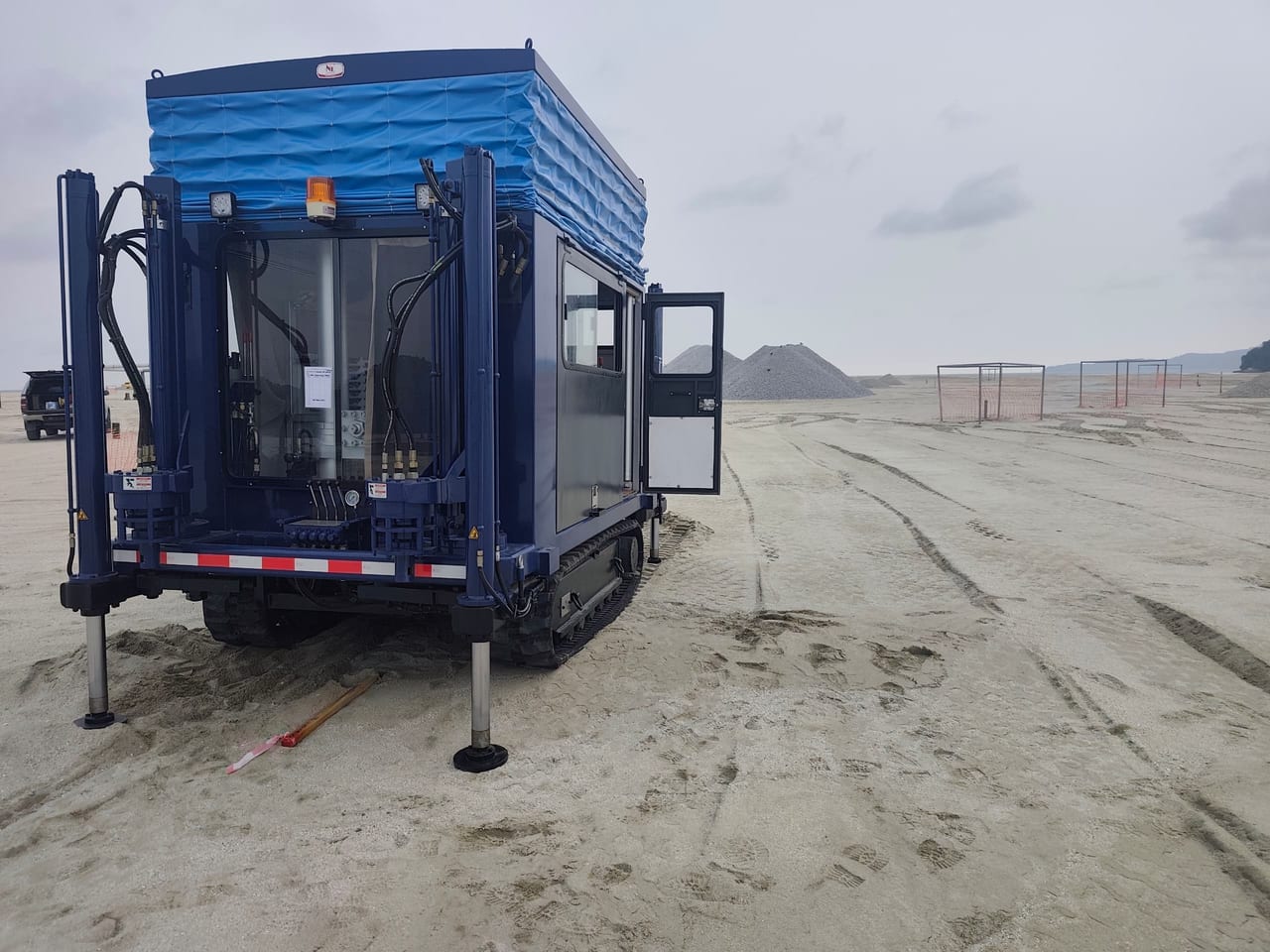
DYLC-Z25-X crawler CPT rig
A fully hydraulic, tracked rig that uses its own weight for reaction, built for cone penetration testing on soft and difficult ground.
| Rated penetration force | 200 kN |
|---|
| Rated lifting force | 250 kN |
|---|
| Stroke | 1,100 mm |
|---|
| Chassis | Tracked crawler, 600 mm tracks |
|---|
| Weight | 20 t including counterweight |
|---|
| Cone sizes | 10 cm² and 15 cm² |
|---|
| Power | 88 kW |
|---|
Supplier catalogue specification.
Questions
What is the difference between CPT and CPTU?
CPTU adds a pore-pressure sensor to the cone. It shows drainage behaviour and helps identify thin clay and sand layers.
How deep can a CPT go?
It depends on the ground: dense sand, gravel or rock stop the push. We plan depth and locations with you for each site.
Do I still need boreholes?
Usually yes. Boreholes give samples to confirm soil types and for laboratory testing; CPT fills in the detail between them.